This is a machine-translated text that may contain errors!
The Core of the Operating System
When thou savest a file, thy programme doth require access unto storage. When sundry programmes run in concert, they crave both processor time and memory. The kernel of the operating system is that portion which tendeth to such resources and granteth programmes controlled leave thereto.
Herein shalt thou be able to expound upon the labour the kernel performeth, distinguishing it from the operating system as a whole and from the interface presented unto the user.
Place within this series: This is Part 3 of Operating Systems. [[Operating System Level 1 - What is an operating system|Part 1]] elucidateth the entirety; [[Operating System Level 2 - GUI and CLI|Part 2]] displayeth the interfaces. Commence there if these concepts are novel unto thee. This page serveth also as foundation for virtualisation and containers in Vg2.
The Core is a Part of the Operating System
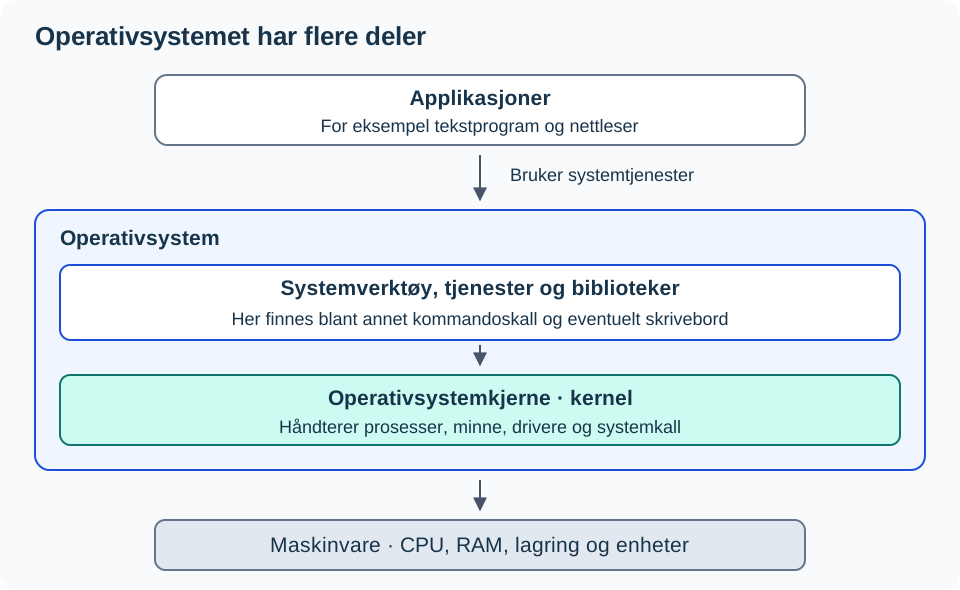
An operating system containeth more than merely the core. It doth possess libraries, system services, and instruments which render the system both usable and manageable to administer. A command shell or a graphical desktop granteth thee an interface unto the system.
Therefore mayest thou remove the desktop from a Linux server yet still retain a functioning operating system. The core and other requisite parts of the system remain in their place.
What Doth the Kernel Achieve?
| Resource or Task | The Kernel’s Dominion Therein |
|---|---|
| Processor (CPU) | It divideth processor time amongst processes, that is to say, programs in execution. |
| Memory (RAM) | It governeth memory regions and guardeth them against unauthorized access from other processes. |
| Storage and Devices | It granteth access through file systems and drivers, among others. A driver be software which tendeth unto a specific sort of device. |
| Privileges | It checketh many petitions from programs regarding the rights of user and process alike. |
When a program doth require a service from the kernel, it employeth a system call, oftentimes by way of a library. The program runneth usually with fewer privileges than the kernel itself. This be an important boundary within the system.
An Exemplar: Thou Dost Store a Text File
- Thou dost select Save within thy text programme.
- The programme entreateth the operating system to inscribe data unto a file.
- The kernel doth attend to the petition, amongst other things, rights and access through the filesystem and drivers.
- The programme receiveth tidings of the outcome and may shew that the saving hath prosper’d or fail’d.
The self-same sort of service is employ’d whether the petition beginneth in a graphical programme or by commandment. Both GUI and CLI be interfaces for man; ‘tis the kernel which tendeth to the resources of the state. This exemplar is simplifi’d: caching and all particulars concerning writing unto a physical disc are omitted.
Linuxe, Debiane & Ubuntue: What is what?
The Linuxe kernel be the name of an operating system’s core. In common speech, this name doth also denote whole operating systems built upon Linux. A distribution of Linuxe, such as Debiane or Ubuntue, doth assemble the kernel with libraries, tools, installation programs, and package systems.
| Term | Relation to other parts |
|---|---|
| The Linuxe Kernel | One part within a Linux-based operating system. |
| Debiane & Ubuntue | Distributions that build upon the Linuxe kernel; they may employ different kernel versions and configurations. |
| Gnome & Kde Plasma | Examples of graphical desktop environments; one may install them or remove them without altering the very kernel itself. |
| Basse | A command shell enabling thee to use commands; it is a programme, not the kernel. |
Examine a Linux Machine, if thou hast one
In a Linux terminal mayest thou read the name and version of the kernel that runneth:
The provided input contains no comments; therefore, it is returned unchanged as per your constraints.
uname -s
uname -r
The first command shall display Linux. The second revealeth the kernel version upon this very machine alone; it need not be akin unto thine fellow’s. These commands alter nought nor require sudo.
To discern which distribution of Linux thou dost employ, one must read another piece of information:
cat /etc/os-release
Seek thou out PRETTY_NAME, such as a name that doth contain Debian or Ubuntu. The core version and the distribution version be distinct matters indeed. Employ this passage upon Linux; ‘tis no need for thee to install Linux in order to perform the self-test below.
For What Reason Dost Thou Behold The Kernel In Virtual Machines And Containers?
A virtual machine runneth a guest operating system with its own kernel unto itself. Linux containers partake of the kernel belonging to that Linux system upon which they dwell. When Docker doth operate within a Linux virtual machine, the containers share the kernel of said virtual machine.
Behold the map of operating systems, virtual machines, and containers for the relationships thereunto pertaining, and the resource concerning containerization for the illustrated comparison thereto related.
Voucht Upon Thy Reasoning
- Thou dost expel GNOME from a Debian-server. Hast thou also cast out the kernel? Give cause for thine answer.
- Two programs store files at one and same time. Which part doth handle access unto system resources?
uname -randPRETTY_NAMEshew differing version numbers. Why may both be true?
Vouch upon the Answer: GNOME is the desktop environment, and its removal doth not of itself remove the kernel. The kernel hath charge over programs’ access unto system resources, in league with other parts of the system. uname -r sheweth the kernel’s version, whilst PRETTY_NAME describeth the distribution.
Thou art ready to proceed when thou canst explain the difference ‘twixt operating system, kernel, and user interface with an example of thine own devising. If thou dost mingle the parts, use the figure and trace the file writing once more. Wilt thou inquire further, declare how two distinct Linux distributions may build upon the like type of kernel.
Sources: Red Hat: The Linux Kernel, Linux-based Operating Systems and uname. The illustration was drawn for this resource.